|
Cerf-island, Seychelles
Cerf
Island lies off the north coast of Mahe in the
Seychelles.
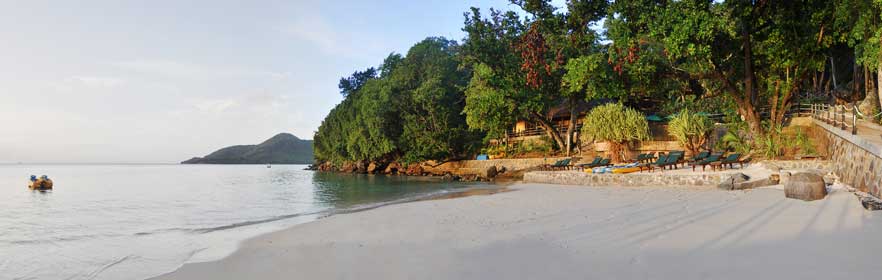
Fifteen minutes by boat from Mahe, this small island appears as an apparition in its surreal and lush unspoilt beauty. Dazzling white beaches sparkle like diamonds in a crown.
Cerf Island was named after the French fregate Le Cerf ("the deer") which arrived at Port Victoria on 1 November 1756. On board was Corneille Nicholas Morphey, leader of the French expedition, which claimed the island by laying a Stone of Possession on Mahe, Seychelles' oldest monument, now on display in the National Museum, Victoria.
The island lies in the Saint Anne Marine National Park and is surrounded by a coral reef. The geology is granitic, with a maximum height above sea level of 357 feet.
Cerf Island measures more than 1.5 km long (about 1 mile) and almost 1 km wide (almost of a mile), it reaches a height of 108 m (357 feet) and lies 3 km east of Mahe.
Due to Cerf Island's location, in a National Marine Park, the waters around Cerf Island prove a spectacular sight. The deepest point of the Marine Park is 250 meters (820 Feet) and the Park offers exceptional marine life, with more than 150 species of reef fish, crabs, sea urchins, starfish, octopus and many more.
On the north side of the island are superb coral reefs. Here giant tortoises swim with clown fish.
Cerf Island is the only island in the marine park to have a small local population who commute to Mahe for their daily business. They live on the opposite side of the island. It has a population of around 100, mostly centered in one bay on the South side of the island.
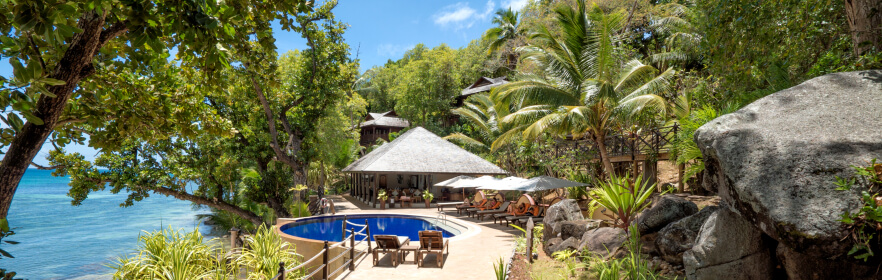
Diving centres are plentiful on the main island and snorkeling equipment is available for hire at Cerf Island Resort.
Rumour has it that the island is not only home to the fruit bat but also home to celebrated South African novelist Wilbur Smith. Well-known residents include Wilbur Smith, the novelist, William "Bill" Travis, the writer, explorer and treasure hunter and Phil Southwell, the yacht designer.
There are no shops, roads or local infrastructure but water, telephone and electricity is provided from the mainland.
Travel to and from the island is exclusively by boat.
Click here to view Special Offers at the Cerf Island Resort
|